Sunday, May 22, 2011

Luxor, Egypt


May 16, Luxor, Egypt.  Second day viewing Egyptian antiquities.  We see huge stone temples, hear endless stories of dynasties and their pharaohs, empires, conquests, gods.  Our guide, with his college degree in Egyptology, rattles off the names of more pharaohs than I can remember.  The only ones that stick are Tutankhamen, Cleopatra, and Elizabeth Taylor.  I learn that Moses was born and raised in Luxor, and went on to lead a life of biblical proportion. 

Of course the stories we hear are mostly written by the winners.  Losers rarely had the opportunity to tell their side of the story.   We spend a pleasant day strolling though ancient temples, hearing interesting stories about the leaders who built them and the warriors who destroyed them.

Perhaps the most impressive structure we see is the temple of Karnac - a massive achievement in engineering and art constructed over many decades under the rule of many pharaohs.  Much of the temple is intact, although the wood/thatch roofs have long since disappeared.  The scale of the place is remarkable and provides clear evidence that pharaohs suffered from the same affliction as modern societies - that pathological need to compete with one's neighbors, often disregarding fiscal prudence.

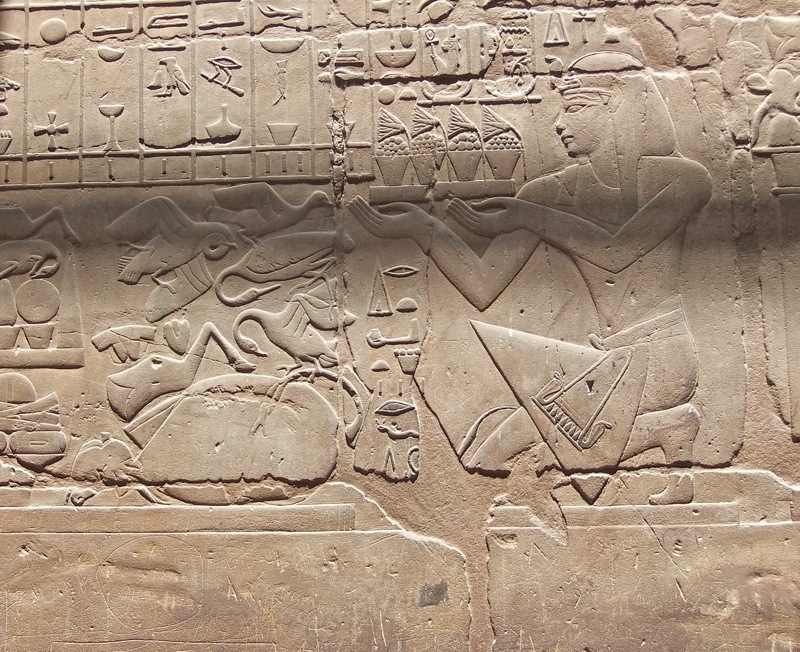
Karnac is huge. One section has 134 massive stone columns, some 70' tall and 10' wide.  Each column, plus all of the walls of the temple are etched with hieroglyphics and scenes depicting many of Egypt's hundreds of gods.  The symbolism of the art provides a window into the beliefs of these people.  There are many rooms, many huge statues and several obelisks.  There are 70' tall obelisks carved from single pieces of pink granite, transported and placed in the temple as a single piece of stone.  One cannot help but be impressed by the place, and to notice the most important lesson of all - the builders are no longer here, long ago replaced by an endless succession of empires and conquest, decay and new beginnings.

After a long morning of antiquity, we have lunch, then board a chartered propeller plane to fly 300 miles to Cairo.  We drive through the energetic, polluted, and decaying city of Cairo, past Cairo Square, the site of recent protests.  We check into our fashionable hotel overlooking the Nile.

Tonight we'll enjoy modern luxury and comfort, dine with fellow travelers.  Tomorrow we'll see the crumbling pyramids, situated on the edge of the crumbling city of Cairo.

Karnac by night


Karnac by day


Shaded areas retain their original coloring


Welcoming committee of Karnac

Afternoon heat zaps energy

Christian crusaders tried to edit anatomically correct artwork


Respite from afternoon heat

Symbolism is everywhere


Repair work is continuous job


Columns crowns resemble lotus flower

Read between the lines


Street in Luxor

Due to quirky tax laws, most building here are unfinished

Lots of bicycles in Luxor

Our prop plane to Cairo

Look closely at this one


Saturday, May 21, 2011

Valley of the Kings


May 15, Valley of the Kings, Egypt. 

There once was a river called Nile,
That supported great pharaohs in style,

With gods they were chummy,
Dressed up as a mummy,

These kings of the valley of Nile.

Our three-day tour of Egyptian antiquity begins in Luxor.  We drive four hours from the Red Sea town of Safaga, through the Eastern Desert.  Gradually the vast expanses of sand give way to the green patchwork of family-owned farms, busy with laborers and donkeys, harvesting the gifts of the Nile.

We arrive in Luxor, located about 400 miles south of Cairo.  In ancient times they called it Thebes, which served as the capital of Upper Egypt.  Today it's a center for tourism and agriculture.  We check into the Hilton Hotel overlooking the Nile.  After lunch we drive to our first stop - the Valley of the Kings. 

Ancient Egyptians were firm believers in an afterlife and spared no expense to give their leaders a royal sendoff.  They knew how to mummify bodies and believed it necessary to equip their deceased with plenty of furniture and other objects.  The mummified bodies were ensconced in underground tombs along with a collection of furniture and other worldly items.  Near the town of Luxor is a site with many such tombs. 

Known as the Valley of the Kings, this site is situated in a rocky, bone-dry valley, where for hundreds of centuries Egyptian pharaohs, kings and some of their families were mummified and entombed.  Archaeologists have unearthed 62 tombs so far, and work is underway to find more.  Tomb size varies, but the design comcepts are always the same.  We hear some of the stories of the lives of these rulers, of their conquests, family disputes, incestuous reproductions, and colorful behaviors.  The stuff of tabloid magazines.

We visit 4 tombs.  In each tomb we walk underground through the long corridors leading to the final chamber.  Inside the chamber is the sarcophagus which holds the mummified remains of the deceased leader.  In adjacent rooms, if they have not been stolen over the centuries, are furniture and artifacts that the king would need in his or her afterlife.  The smallest of these tombs is that of Tutankhamun, the famous boy-king who died at age 19.

Egyptian royalty were not minimalists.  Their tombs are elaborately decorated with colorful hieroglyphics and drawings on almost every possible surface.  We are not allowed to bring cameras inside, though I do manage to sneak a few photos on my cell phone.  Given the thorough corruption that is part of Egyptian culture today, it would be easy to slip a few dollars to any of the 'guides' inside the tombs, and thus buy the privilege of taking some pictures.  However I can get much better photos from available postcards.

One of the realities of visiting ancient Egypt is dealing with the culture of modern Egypt.  Tourism virtually stopped during the January/February protests here.  Two months later it is probably no less safe than before the protests, though most tourists are still staying away.  With a paucity of tourists dollars, the young, mostly uneducated hawkers behave desperately. 

They hound tourists with in-your-face aggressiveness, trying to sell their junky trinkets.  Some tourists feel pity and buy junk they neither want nor need.  Others play the game, turning it into an art-form.  Tourists can show a slight interest in a trinket, then refuse every possible price, including free.  They can return to the bus, feigning indignation and contempt toward the hawker.  Once the tourist gets back on the bus, the hawker knows to stand outside his window, signaling surrender to the traveler, who at that point gets off the bus and pays $5 for two of the trinkets that were originally priced at $25 each.  And thus concludes the transaction in which a hawker sells what he doesn't want, to a traveler who purchases what he doesn't need.  To formally close this deal, both parties are required to express final regret and disappointment that they did not get a better price.

For those not interested in material acquisitions, the persistence of the hawkers is bothersome.  There are two methods of dealing with this.  The first is to simply pretend that the hawkers do not exist.  I call this the "there is no spoon" method.  The second is to make it completely clear to the antagonist that you would rather sleep with cobras than buy their postcards.  This second method is not as effective however, because most hawkers will interpret any acknowledgment of their existence as an opening bid.

I leave the Valley of the Kings wondering what the great pharaohs would have thought about the dynamics of today's tourism.

Vast desert enroute to Luxor
Friendly locals wave to tourists

People in Luxor
  
Luxor today


Inside tomb of Hatshepsut

Hilton Hotel on Nile river
Small farms near Luxor

Saturday, May 14, 2011

Safaga, Egypt


May 14, Safaga, Egypt.  Located in the northeastern corner of Africa, Egypt is mostly desert.  There is the western desert, located west of the Nile, and as you might have guessed, the eastern desert located east of the Nile.  Then there is the Sinai desert on the Sinai peninsula, home to the resort town of Sharm el-Sheikh.  The southern half of Egypt is called 'upper Egypt' since it sits at a high elevation.  The northern half of the country is called 'lower Egypt' named for its low elevation.

For those who are just plain tired of sand, there is the Nile river and its fertile valley.  This productive region comprises just a small percentage of this country's land mass.  As a famous waterway, the Nile is not only the longest river in the world, it is also very easy to rhyme with other words.  Try it sometime, or better yet try writing a limerick about it.

In 1971 the Aswan High Dam was built to control this mighty river and it is now considered one of the modern wonders of the world.  River cruises here are quite popular among tourists.

Tomorrow we will begin visiting the many temples, tombs and tall pointy buildings known as pyramids.  But for our first day in this historical country we drive to an undisclosed location in the middle of nowhere.  After about 90 minutes of riding across a bumpy path in a rugged old Toyota Land Cruiser, we arrive at a Bedouin village, situated in a flat desert valley floor, surrounded by unnamed rugged dry mountains. 

This Bedouin culture is quickly disappearing and we learn that this village would not exist at all if not for the tourist industry.  Today only the very old Bedouins cling to their true nomadic ways, insisting on sleeping in tents from which they can see the night sky, or as they call it, their 100-star hotel.  They still drink only spring water, raise goats, travel by camel, and use herbal medicines instead of pharmaceuticals.  But the government is successfully converting these ancient nomadic peoples into more modern settlers, setting down roots in new government housing, assimilating into modern society.  It's a slow process, succeeding mostly by the passing of the older generation, as the younger Bedouins learn the currency game. 

Bedouins in other middle eastern countries are also being phased out as their way of life clashes with the settled world.  The young Bedouins sell their handicrafts to tourists, but more importantly showcase their nomadic heritage to curious travelers.  We visit one of these villages and see the very primitive way in which these people lived for thousands of years.  They are clever in using nature's gift to sustain themselves.  For example, they use camel dung to fuel their cooking fires, as shown in the photo of the woman cooking flat bread atop this page. 

Overall however, the village seems semi museum-like, not real.  Water has all but disappeared, threatening their nomadic livelihood.  I peek my head into one hut and notice a television, then see a satellite dish on the roof.  A Toyota pickup truck is parked under a reed hut.  One of their problems is their shrinking population, which reduces the gene-pool to unhealthy levels, especially since they rarely marry outside of their group.  They do have a working well, some 130 feet deep, operated by a long rope with a bucket, though they've also added modern piping and pumps.

I ride a camel, which is required for all first time tourists in Egypt.  To me these Bedouins appear as a mere shadow of their former selves.  Our tour guide speaks a bit about the long history of Egypt, with its many dynasties, its pharaohs and conquests by Greek, Roman, Byzantine, Ottoman and Arab empires, not to mention French and British influence.

Then he talks about modern Egypt.  I've learned to read between the lines for similar speeches by glass-half-full tour guides.  He speaks openly about the new revolution that began on January 25 this year, in which regular Eqyptians managed to oust Mubarak and end his 30-year reign.  Mubarak and his sons are now in jail, according to our guide.  He admits that this revolt virtually stopped tourism for 2 months, but that business is now picking up.  He claims Cairo is very safe today.  He is clearly proud of the revolution and says he and other guides physically protected the famed Egyptian museum in Cairo during the protests.  The missing piece of his story however is that he cannot explain any clear path to replace the ousted Mubarak.  The protesters 'threw the bum out' without a plan of how to replace him.

So we keep our fingers crossed for Egypt as well as other populations in the middle east that are striving for reforms.  We return home to the ship, getting just a brief introduction to this country.  Tomorrow begins a three-day tour of pointy buildings, temples and other attractions.


Caravan at the Bedouin village


Guide talks about Egypt

Man peers down water well

Real loom for making camel-hair rugs

Reed huts


I ride a camel

Petra, Jordan


May 13, Petra, Jordan.  The ancient city of Petra is perhaps the most impressive of Jordan's thousands of archaeological sites.  To get here from our last stop in Oman took five days.  First we sailed through the pirate-infested waters of the Gulf of Aden, which lies between Yemen and Somalia.  We actually saw some pirates in their small, fast boats, watching us from a distance.  The captain wisely prepared for this possibility by issuing squirt guns to all passengers.  Apparently this worked, because none of the pirates decided to mess with us.

After almost two days sailing west, we hung a right at the Red Sea and headed north.  We were disappointed to discover it is not actually red.  We passed the tiny African nation of Djibouti, then sailed past its northern neighbor, Eritrea, which is reportedly the hottest place on Earth.

We continued north through the Red Sea, past Saudi Arabia on our starboard side and Sudan and Egypt on our port.  When we reached the Sinai peninsula, we went right, through the narrow Gulf of Aqaba.  Finally we arrived at the Jordanian city of Aqaba, which is very close to the borders of Egypt, Israel and Saudi Arabia.  It is a long way from Jordan's eastern neighbor, Iraq, or their northern neighbor, Syria.

Aqaba is a fairly attractive seaside port of perhaps 150,000 people.  Our final destination however is Petra, so we take a two-hour bus ride along the King's Highway, which reportedly was used by Moses of biblical fame in 1,300 B.C.  His brother is buried in the hills near this ancient roadway.

Jordan's population is a about 90% Muslim and 10% Christian.  Unlike Saudi Arabia, their neighbor to the south, Jordan does not have any oil.  They are a relatively poor nation, although they are very politically and socially moderate relative to most of their Arab neighbors.  They have a population of six million.  During the two-hour bus ride, our tour guide talks at length about the history of Jordan, which extends thousands of years before the creation of Islam.  He tells of the many biblical stories that took place in Jordan. 

Along the way we pass Wadi Rum, the beautiful desert valley made famous by the twentieth century military commander named T.E. Lawrence, or as his friends called him 'scary Larry'.  Hollywood eventually produced a film about him called Lawrence of Arabia.

After our bible stories and endless views of arid desert and equally arid mountains, we finally arrive in Petra.  We hike through a dry narrow canyon bordered by tall sheer sandstone cliffs.  Along the way, we see remarkable carvings in the sandstone - some of Greek-style facades, some of human figures and some of animals.  There are ancient water channels used by those who lived here a long ago. 

After about two miles of hiking, the canyon opens up and we stand in awe of a massive Greek/Roman looking structure carved completely by hand from massive sandstone cliffs.  They call it the 'Treasury.'   Many smaller structures are also in this area, including an amphitheater, tombs, cave housing, and temples, all hand-carved into the sandstone.  We walk into a few of these large rooms and are amazed at the naturally colorful stripes created by the various layers of sandstone.  I meet a man who was born in these caves and still lives there, carrying his water in a bucket every day from the natural spring about 1 mile away. 

There are a few peddlers selling jewelry, post cards, and camel rides.  Most of the tourists are Jordanian, though there are many westerners as well.  If you want to learn more, google 'Petra'.

We are told that to fully explore this ancient city would take at least 3-4 days, but we spend only a few hours there.  We hike back, stop at a nearby modern hotel and have a nice Jordanian lunch.  We leave Petra, marveling at the ancient accomplishment of chiseling such beauty into the massive cliffs.  Perhaps the poem by Burgon says it best:  "Match me such a marvel save in Eastern clime / A rose-red city half as old as time."

We travel back along the King's Highway, back to our ship.  Next stop Egypt.

Treasury of Petra


Camels for rent

View of canyon from Treasury


Amphitheater

Striated sandstone

Beautiful sandstone inside

Remarkable colored sandstone

Hnad-carved room


Modern neighborhood outside of Petra

Seaside port of Aqaba