Saturday, May 28, 2011
Israel
May 18-20: Israel. Another day, another country, last stop in the middle east. I spend three days in Israel, touring this thoroughly modern country with a thoroughly ancient history. Lots of holy sites, biblical significance, and ruins of past empires. Yet very modern, advanced technology, vibrant culture, democratic, strong economy. Population is almost 8 million, land mass slightly less than New Hampshire. Much of the land is desert, though they have turned it into very productive agriculture, pioneering efficient irrigation systems. Hebrew and Arabic are the official languages, though English is widely spoken, taught in grade school, and written on many signs. Twenty percent of the population is Arab, the rest are mostly what they call cultural Jewish, while some are very religious orthodox Jews.
Like all places that have been continuously inhabited by agrarian cultures for at least several thousand years, the layers of history are vast. On tour we see a few selected highlights, hear a few selected stories. As visitors we are interested in trying to understand the current politics, but that is beyond the expertise of our tour guide, beyond the scope of our brief visit. I hear a story that back in the early 1970's, a senior U.S. state department official thought he figured out the solution to conflict between Israel/Palestine. He went to Henry Kissenger, the then U.S. Secretary of State, excited to share his idea. Kissenger immediately corrected the senior official by telling him that there is no solution to this conflict, and that the job of diplomats in that part of the world was not to solve these problems, but to manage them.
Our first day we visit the modern business city of Tel Aviv, its older neighbor Jaffa, and the ancient city of Caesarea a few hours north. Tel Aviv is on the coast and has a very nice beach and a modern skyline. Lots of construction going on. Streets are clean, lots of people walking, sidewalk cafes are busy. Nearly half of the population of Israel lives in this metropolitan area. Plenty of high-tech industry.
In Caesarea we view ancient ruins of buildings and a harbor built under the rule of Herod the Great during the decades before Christ. This pro-Roman general also expanded the second Jewish temple in Jerusalem. Unfortunately his tradition of great accomplishments ended when he died. He was succeeded by his son, Archelaus the Not-So-Great.
On our second day we drive south, through the Negev desert. We see vast expanses of farms, drive on a well-paved highway. We arrive at the lowest point on Earth - the Dead Sea, 1,300 feet below sea level. Previously known as the salty sea, this body of water is now named 'Dead' either because the water that drains into it from the Jordan river has no place to go but up (lowest point on Earth), or because nothing can live in this highly concentrated mineral water. This sea is shrinking by about one meter per year, so it may not be around much longer.
Some people go to the Dead Sea for therapeutic reasons, to bathe in the mineral waters or mud baths. Others just go for the novelty of floating in water in which one cannot sink. It's a weird feeling, being so buoyant that you cannot even force an arm or leg down into the water without another limb popping up into the air for counter-balance. Some say that at such a low elevation, the atmosphere is too thick for the sun's UV rays to penetrate, thus removing the need for sunblock. After the Dead Sea, we visit the nearby hilltop fortress of Masada. There we learn of the heroism and tragedy of the Jews who fled the Roman army and escaped to this location in around 70 A.D.
On our third day, we visit Jerusalem. It serves as the political capital of Israel and together with Bethlehem and Nazareth has many of the world's holiest sites. Jerusalem is divided into four sections - Jewish, Christian, Muslim, Armenian. It is an attractive city with low-rise buildings, generously landscaped and set among rolling hills. All of the buildings by law must use the same Jerusalem limestone, which creates a visually pleasing homogeneous effect. It is a vibrant place, lots going on, lots of people walking in the neighborhoods.
Because of its many holy sites, Jerusalem receives many visitors. Nazareth and Bethlehem are the most popular as thousands try to trace the presumed footsteps of Jesus. The iconic Dome of the Rock is in the old city of Jerusalem, marking both the spot where the prophet Mohammed ascended, and the location of the destroyed Jewish temple. The western wall of the old city is known as the 'wailing wall', a place where Jews have prayed since destruction of their second temple long ago. We visit the Holocaust museum, which is an extremely well-researched and well-designed facility that carefully conveys the story of those tragic events from 70 years ago, during WWII. It is a heart-wrenching, yet important stop on this tour and helps to explain why the state of Israel was created in 1948.
On our drive back to our ship, we pass through the northern seaside town of Haifa. Far from the political capital and without notable ruins, it is an attractive, modern city, with diverse people, known for getting along, not getting caught up in cultural conflicts. Wish we had more time here, but like so many stops in interesting places, our visit ends too early. We leave Israel, impressed with their ability to thrive in a challenging environment, interested in their everyday realities, curious about the future of this complicated place.
Tel Aviv
Ruins in Caesarea
Tram cables to Masada
View from Masada
Location where Dead Sea Scrolls were found
Local visitors to Wailing Wall
Wailing Wall has separate entrances for men & women
Wailing Wall
Street Festival in Jerusalem
Soldier carrying unloaded weapon home for weekend
Baha'i Garden in Haifa
Street in Haifa
Sunday, May 22, 2011
Cairo, Egypt
May 17, Cairo, pyramids. We begin our tour in Cairo with a visit to the Egyptian museum. Appropriately, they have the largest collection of Egyptian antiquity in the world. The building is somewhat in disrepair, though the collection itself is very good. Unless you are an Egyptologist, the sterile nature of the museum yields an unmemorable experience.
After the museum we have lunch at a fancy hotel, then visit the famous pyramids of Giza. They are basically across the street from the hotel, right at the edge of Cairo.
There are three large pyramids and a handful of smaller ones. There is a big parking lot on land overlooking the structures, and we stop there for photos. This being modern Egypt, the area is crawling with opportunistic peddlers and scammers. We get out of the bus to snap pictures. Next thing I know, I'm on a camel with a scarf on my head, and some young Egyptian guy has my camera and is taking my picture. They want money of course, though never ask for it. I give each of the three scammers $5, total of $15. They try to refuse the money, arguing it is not enough - camels are expensive to maintain, they need $60. I unilaterally negotiate and they end up accepting the $15. I return to my bus, simultaneously feeling sorry for them and annoyed at them. Other travelers have similar experiences.
We drive closer to the pyramids, get out and walk around. There is a line of people waiting to go into the largest one, but we don't have enough time to do this. We walk the area, noticing the energy in the air, snapping photos, trying to avoid the pesky peddlers. After a brief stop here, less than an hour, we get back on our bus to leave Cairo. The visit to these iconic structures turns out to be gratifying in that we can all cross this item from our bucket list. Yet the visit itself is anti-climatic. Our guide does not explain the significance of these tall pointy buildings, and after nearly 72 hours of touring in Egypt, none of the passengers have the energy to ask. I do notice that up close, the structures are crumbling. They won't be around forever.
After the pyramids we visit the sphinx. It is also decaying, though still retains some of its drama. Today it serves as another photo stop for tourists and an opportunity for hawkers and scammers.
We get back on our bus and drive several hours to Port Said, named for one of the prominent men responsible for the Suez Canal, opened in 1869. There we board our ship and leave Egypt, heading to Israel, our final stop in the middle east.
Cairo & Nile at night viewed from hotel
Streets of Cairo
Building burned by protesters in January 2011
Tall pointy buildings
Two camel scammers
After the museum we have lunch at a fancy hotel, then visit the famous pyramids of Giza. They are basically across the street from the hotel, right at the edge of Cairo.
There are three large pyramids and a handful of smaller ones. There is a big parking lot on land overlooking the structures, and we stop there for photos. This being modern Egypt, the area is crawling with opportunistic peddlers and scammers. We get out of the bus to snap pictures. Next thing I know, I'm on a camel with a scarf on my head, and some young Egyptian guy has my camera and is taking my picture. They want money of course, though never ask for it. I give each of the three scammers $5, total of $15. They try to refuse the money, arguing it is not enough - camels are expensive to maintain, they need $60. I unilaterally negotiate and they end up accepting the $15. I return to my bus, simultaneously feeling sorry for them and annoyed at them. Other travelers have similar experiences.
We drive closer to the pyramids, get out and walk around. There is a line of people waiting to go into the largest one, but we don't have enough time to do this. We walk the area, noticing the energy in the air, snapping photos, trying to avoid the pesky peddlers. After a brief stop here, less than an hour, we get back on our bus to leave Cairo. The visit to these iconic structures turns out to be gratifying in that we can all cross this item from our bucket list. Yet the visit itself is anti-climatic. Our guide does not explain the significance of these tall pointy buildings, and after nearly 72 hours of touring in Egypt, none of the passengers have the energy to ask. I do notice that up close, the structures are crumbling. They won't be around forever.
After the pyramids we visit the sphinx. It is also decaying, though still retains some of its drama. Today it serves as another photo stop for tourists and an opportunity for hawkers and scammers.
We get back on our bus and drive several hours to Port Said, named for one of the prominent men responsible for the Suez Canal, opened in 1869. There we board our ship and leave Egypt, heading to Israel, our final stop in the middle east.
Cairo & Nile at night viewed from hotel
Streets of Cairo
Building burned by protesters in January 2011
Tall pointy buildings
Two camel scammers
Luxor, Egypt
May 16, Luxor, Egypt. Second day viewing Egyptian antiquities. We see huge stone temples, hear endless stories of dynasties and their pharaohs, empires, conquests, gods. Our guide, with his college degree in Egyptology, rattles off the names of more pharaohs than I can remember. The only ones that stick are Tutankhamen, Cleopatra, and Elizabeth Taylor. I learn that Moses was born and raised in Luxor, and went on to lead a life of biblical proportion.
Of course the stories we hear are mostly written by the winners. Losers rarely had the opportunity to tell their side of the story. We spend a pleasant day strolling though ancient temples, hearing interesting stories about the leaders who built them and the warriors who destroyed them.
Perhaps the most impressive structure we see is the temple of Karnac - a massive achievement in engineering and art constructed over many decades under the rule of many pharaohs. Much of the temple is intact, although the wood/thatch roofs have long since disappeared. The scale of the place is remarkable and provides clear evidence that pharaohs suffered from the same affliction as modern societies - that pathological need to compete with one's neighbors, often disregarding fiscal prudence.
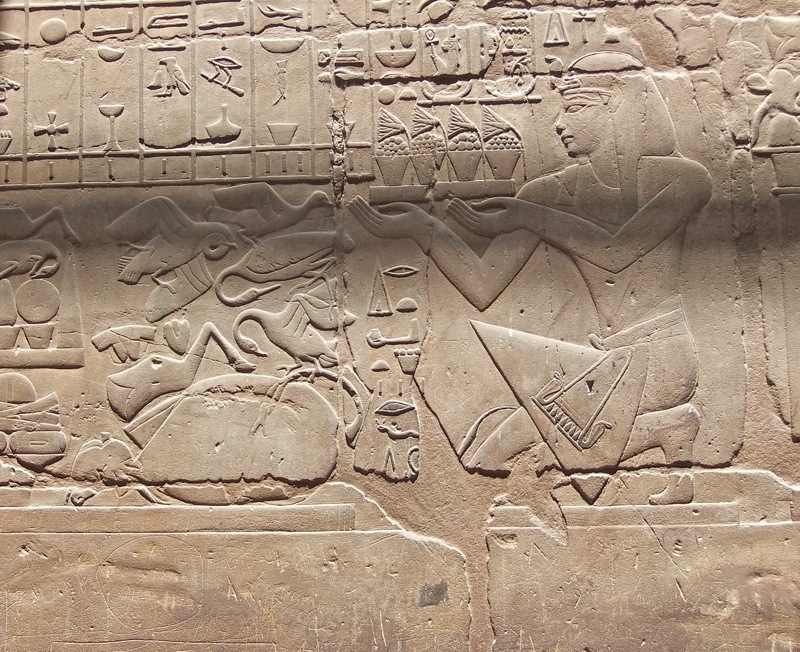
Karnac is huge. One section has 134 massive stone columns, some 70' tall and 10' wide. Each column, plus all of the walls of the temple are etched with hieroglyphics and scenes depicting many of Egypt's hundreds of gods. The symbolism of the art provides a window into the beliefs of these people. There are many rooms, many huge statues and several obelisks. There are 70' tall obelisks carved from single pieces of pink granite, transported and placed in the temple as a single piece of stone. One cannot help but be impressed by the place, and to notice the most important lesson of all - the builders are no longer here, long ago replaced by an endless succession of empires and conquest, decay and new beginnings.
After a long morning of antiquity, we have lunch, then board a chartered propeller plane to fly 300 miles to Cairo. We drive through the energetic, polluted, and decaying city of Cairo, past Cairo Square, the site of recent protests. We check into our fashionable hotel overlooking the Nile.
Tonight we'll enjoy modern luxury and comfort, dine with fellow travelers. Tomorrow we'll see the crumbling pyramids, situated on the edge of the crumbling city of Cairo.
Karnac by night
Karnac by day
Shaded areas retain their original coloring Welcoming committee of Karnac Christian crusaders tried to edit anatomically correct artwork Respite from afternoon heat Symbolism is everywhere Repair work is continuous job Columns crowns resemble lotus flower Read between the lines Street in Luxor Due to quirky tax laws, most building here are unfinished Lots of bicycles in Luxor Our prop plane to Cairo Look closely at this one |
Subscribe to:
Posts (Atom)