Sunday, May 8, 2011
Oman
May 5, 7: Oman. We make two stops in this small monarchy, located at the southeastern tip of the Arabian peninsula, overlooking the strait of Hormuz, great spot for watching the world's oil tankers float by.
First stop is Muscat, then Salalah two days later. Both locations feature low-rise white stucco buildings scattered across the desert in a low density pattern. If you love sand, you'll love Oman.
Buildings are not allowed to exceed 12 stories, and in fact I don't see any that exceed 7. If we were to visit Salalah during their monsoon season in summer, we would see one of the few places on the Arabian peninsula that enjoys any meaningful amount of rain. The region is temporarily transformed into an almost tropical landscape. But for our visit, it appears arid as you would expect of a desert.
The sites in this country are not particularly memorable. We visit the Grand Mosque of Muscat, though are not allowed inside. We visit a small museum and a souk (marketplace) in each city. Some of the stores are run by men and some by women. We visit a wide sandy beach with a clean, calm surf. It's empty, no signs of life other than a few camels. We learn that swimming and beach-going is not part of the culture. We see the outside of the Sultan's palace - a grand building that he uses just for entertaining VIP guests. None of the places we visit, nor the neighborhoods we drive through are crowded. Not a lot of people out and about. Perhaps because of the heat - at least 100F.
The country is roughly the size of Kansas and has a population of around 2.6 million. A fourth of those living here are foreigners, mostly workers from India and Pakistan. The official language is Arabic, though English is now taught in school and widely spoken, at least in the city. Most of what we learn is from our tour guides. Here's the executive summary:
The story of modern Oman begins in 1970, when Qaboos bin Said deposed his father, the previous Sultan Said bin Taimur. Under Taimur prior to 1970, Oman was an insular, repressed nation. There were two schools with a total of 400 students (all boys) for the entire country. A rebellion began in Dhofar in 1962, and by 1970 the new Sultan took over. He immediately began implementing all sorts of programs to modernize his country in anticipation of its oil reserves eventually being depleted.
He began with education, and today there are 1,200 public schools, several universities and a number of private schools. Girls now can attend school and on average get better grades than the boys. Education and health care are free for all citizens. While the political system is a true monarchy, the Sultan has introduced a small degree of democracy by establishing an advisory council made up of 84 elected members. All citizens over 21 years of age or older can vote. Two of the council members are women.
Almost all of Oman's wealth comes from its oil reserves - over 5 billion barrels. They pump around 900,000 barrels per day, so unless significant new reserves are discovered, they will run out of oil in 20 years. This eventuality is the motivation behind the Sultan's efforts to educate, build infrastructure, and thereby diversify his economy.
Driving on the roads outside of Salalah we see lots of camels. Some are on the road itself and drivers must swerve to avoid hitting them. Until modernization, camels were the primary means of transportation, as well as a source of food. Today they are becoming a nuisance and threatening deforestation of the only green area of the country, so the government has been buying camels and shipping them to other countries. If a driver hits a camel during daylight hours, it's the driver's fault. At night, it's the camel's fault, so the camel owner is liable for damages.
With so little rain in most of the country, water is more expensive than oil. Still, there are nice lawns and landscaped public places, all irrigated with reclaimed sewage water. They know not to waste precious potable water.
Almost all of the citizens are Muslim and there are many small neighborhood mosques. Marriages are mostly arranged and it is typical for families to have 6 or 7 children. Almost all of the women wear abayas, and none are without a headscarf. A man may have four wives, but in practice this is rare due to the cost, since each wife must have her own house. The Sultan himself has no children, which will be a concern for the country when the time comes to choose a successor.
Internationally, Oman has received awards and praise from various organizations on issues ranging from peace to cleanliness. It is in fact a very clean place - we don't see any trash. They have good relations with countries ranging from Iran to the U.S. They were the first Arab nation to invite the prime minister of Israel to visit back in the 1990's.
Though oil is their primary business, they do have some agriculture and mining as well as fishing. We learn of some unintended consequences: since the recent increased activity by Somali pirates, Japanese and Korean fishing boats have stopped fishing in this part of the Arabian sea. That has in turn improved the catch for Omani fishermen. Another twist for Oman is their unexpected rise in tourism. Prior to the 9/11 attacks, many Saudi tourists traveled to Europe and North America. After the attacks, for obvious reasons they stopped doing this. Instead many of them now vacation in Salalah during the monsoon season, just to experience the greenery and rain that is so rare on the Arabian peninsula.
From the perspective of a westerner with western sensibilities, the Sultan of Oman seems to be doing the right thing in moving his country forward.
Grand Mosque, Muscat
Our tour guide in Muscat
One of Sultan's palaces
Sultan's yacht
A small mosque
A security checkpoint in the middle of nowhere
Camels roam freely in some areas
Salalah
Notice the tag line (Holidays, Tours & Mice)
Thursday, May 5, 2011
Dubai, U.A.E.
May 3,4: Dubai, U.A.E. This is the second largest emirate of the U.A.E. and has made a name for itself by constructing bold, even outlandish projects, then inviting the world to come and do business here. The tallest building on the planet is here, as well as the first 7-star hotel. They've built man-made islands in the shape of palm fronds, which caused some serious financial challenges when the world economy began its protracted retreat in 2008. Construction continues throughout Dubai however, and it is a visually impressive place. The are reportedly 50 shopping malls, one with an indoor ski slope, some with ice rinks or aquariums. The architecture is the most creative I've seen so far, despite the relatively small population (around 2 million people). Clearly, the sheik of Dubai is trying to use the available oil wealth to make a statement, and to prepare his country for the distant eventuality of running out of oil.
I spend two days riding around this city and seeing various sites. Traffic is orderly and moderate. All of your favorite retail stores are here, including Bulgari, Cartier, Versace and more. Even DeBeers has a store here. And if you're slumming it this week, you can shop at H&M. Restaurants range from the ridiculously over-priced, to familiar franchise names such as Starbucks, Pizza Hut, Outback Steakhouse, and McDonalds. There are patisseries, Italian restaurants, and generally every sort of eatery one could want.
I visit the Dubai Mall, reportedly 12 million square feet of space, of which about half is leasable retail space. I do the math: 275 acres. It has an ice rink, cinema and many other attractions, plus roughly 1,200 retail stores. One of the most dramatic features inside the mall is an aquarium that features what they claim to be the world's largest acrylic panel. This panel forms one side of a huge tank. There are 8' sharks, dozens of manta rays, thousands of fish. The panel is perhaps 100' long and about 20' tall. And it's not in a special area. Shoppers view the fish routinely while wandering the mall.
Almost everyone in Dubai speaks English, and of course the locals all speak Arabic as well. In the mall my mission is to buy a camera and some toothpaste. Replacing my ancient digital dinosaur (3 years old) is easy. There are dozens of idiot-proof point-and-shoot models to choose from. The store clerks all speak fluent English and patiently help me in my selection. Some of the workers are natives, though most are from India or Pakistan. Prices are comparable to the U.S., but no sales tax. The toothpaste is not so easy. I ask an information clerk where I can find toothpaste. In perfect English, he asks "what is toothpaste?" I find the supermarket and eventually acquire my Colgate dental product.
Wandering around the mall, most of the people wear western styles, though there are also quite a few in traditional Muslim dress. Many women in abayas or headscarves, quite a few pushing strollers with one or more young children, and many men also in headscarves and white robes. Many are on cellphones. They all mix seamlessly in the mall. I stop for a snack, sitting at a table next to a couple in traditional Muslim garb. I notice that to eat, the woman lifts her black veil to get food to her mouth, so that even while dining, her face is not viewable.
Other than the absence of sales tax, there are no bargains in Dubai. Prices seem comparable to the U.S. The real bargain belongs to native citizens of the emirates. They have a generous social safety net that provides a comfortable living, so most of the work is done by foreigners. The system seems to work, and while there are some abuses of low-level foreign workers, it has not stemmed the incoming flow of labor.
Next stop is the impressive hotel Burj Al Arab. You can google this hotel and read all about it, which is probably better than any description or photos that I could provide. Our tour includes high tea on the 27th floor of the hotel. Our guide is a woman born in Hungary, married to a man from Syria. She converted to Islam and has been living in Dubai for 16 years. She wears a headscarf, though no burka. She still carries a heavy Hungarian accent, so I find her version of English difficult to understand. This is a typical story in this emirate, with foreigners greatly outnumbering natives.
Viewing the inside of the hotel is a real treat. I've seen lots of fancy hotels all over the world, nestled in various beautiful locations. I must admit that so far, this place is the most memorable. Its design is stunning - over the top, but in a beautiful way. The high tea event is pleasant, conversing with fellow travelers in a ridiculously ornate dining room, comparing notes from our recent visit to India, a place that could not be more different from U.A.E.
After tea we wait outside the hotel for our bus. We watch as a steady parade of the rich and not-quite-famous people roll up to the main entrance into the hotel. We admire the fleet of Rolls Royce cars waiting to transport guests in comfort and style. We view the adjacent beach with vacationers enjoying sun, sand and surf.
Our final stop in this land of too-much-money is the beautiful marina - home to hundreds of attractive yachts, surrounded by outdoor cafes, elegant residential buildings. The place is extremely clean, polar opposite to India. There are beautiful fountains, elegant brick or stone paving, neat landscaping and plenty of color. There is no trash anywhere. Lady Bird Johnson would have been proud.
It is a noticeably uncrowded place. A few diners sit under large umbrellas sipping on ice tea, admiring the surroundings. But most of the chairs are empty, like the roads and buildings. Perhaps everyone has gone to the mall. In eastern religion, nirvana is defined as complete emptiness. In real estate, it's the opposite - crowded, busy and full occupancy is the ultimate goal for property owners. For now, the supply/demand equation has worked against these capitalists, as occupancy rates throughout Dubai remain low.
Still, it's an attractive place with lots to offer. The centerpiece of this part of Dubai is the Burj Kalifa - tallest building in the world. To my eye it is perhaps the most beautiful modern building I've seen. Unfortunately it's not doing well financially. Despite their ample money, or perhaps because of it, the aggressive construction in Dubai during the past decade has fallen victim to the world's economic pendulum. Vacancy rates throughout the city remain high, defaults are common, and if not for their rescue by the neighboring emirate of Abu Dhabi, many lenders and owners of the projects in Dubai would have suffered further losses.
Despite their economic challenges, I leave U.A.E. with respect for what the leaders here have tried to accomplish - to integrate their Muslim culture with the rest of the world in a forward-looking way, rather than backwards. Its an encouraging experiment that at least on the surface appears to work.
Next country: Oman.
One solution for too much money.
Aquarium at the Dubai Mall
Unique twisted building overlooking the Dubai marina.
Another hotel, across from the Burj Al Arab
Reception desk at Burj Al Arab
My group enjoys high tea at the Burj Al Arab
View of Dubai from Burj Al Arab
Fountain inside lobby of Burj Al Arab
27 story atrium inside the Burj
No comment required
Burj viewed from below
Outside the main entrance to the Burj Al Arab
Tallest building: Burj Kalifa
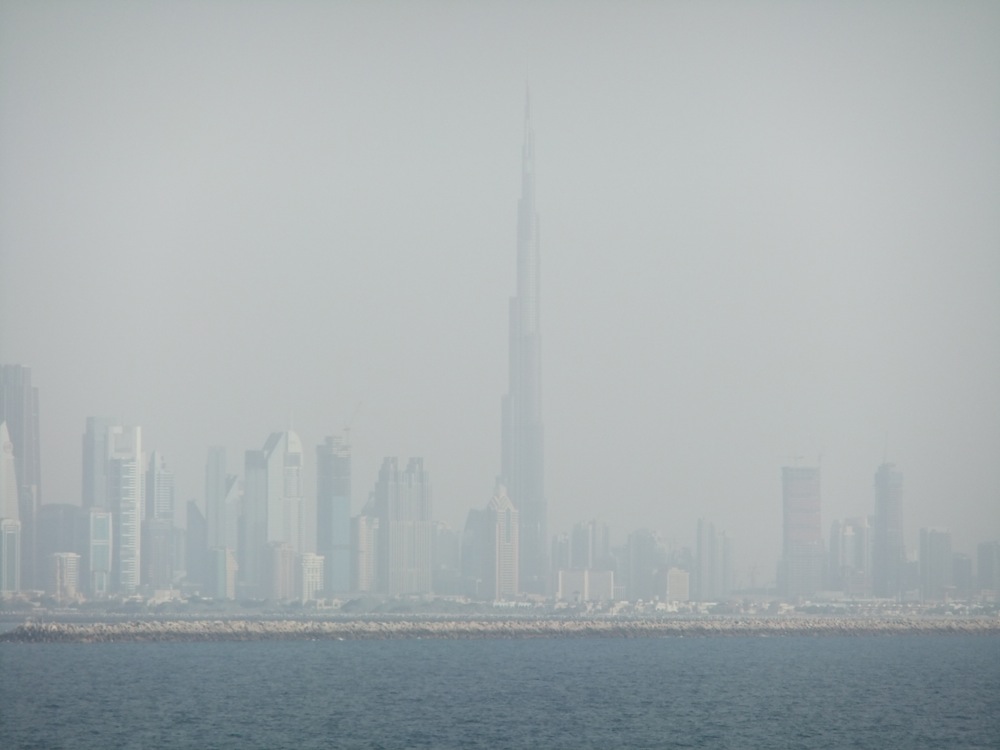
Dubai from 1 mile offshore, obscured by desert winds that raise dust and sand.
Wednesday, May 4, 2011
Fujairah, U.A.E.
May 2: Fujairah, United Arab Emirates. Located in the southeast corner of the Arabian peninsula and bordering the Persian gulf, the U.A.E. is a small country about the size of Maine. It is an oil-rich nation, formed in 1971 through the merger of 7 emirates. Today its population numbers over 8 million, with over 80% of its residents having non-citizen status. Some of the emirates have even higher percentages of non-citizens. Many of these foreigners are from poorer countries, here to work in wealthy, growing economies of Dubai and Abu Dhabi, while others are entrepreneurs or corporate types seeking new opportunities in this zero-tax hub of middle eastern commerce.
In this country we make two stops. First we visit the lesser-known emirate of Fujairah, which is a very clean place surrounded by bone-dry barren mountains and lots of sand. There is a fair amount of construction going on, yet we see very few people, perhaps because of the 100+ degree heat. My tour in Fujairah is just for fun. Rather than taking a bus, groups of four passengers ride in new, air-conditioned Toyota Land Cruisers. We form a caravan of 20 Land Cruisers on our 90 minute drive to the sand dunes. There we behave childishly by driving up and down the dunes as if they were a roller coaster. We get out of the cars every so often to take pictures or just take a break. The temperature reaches 42C, or 108F, though thankfully it is a dry heat. Still, best to stay in the car. One car gets a flat tire, which provides momentary drama.
We see a few camels. We learn that a camel is just a horse designed by a committee. We also see some donkeys. We learn that the donkeys were used many years ago as work animals. Today they are rarely used, so there are lots of unemployed donkeys running wild. On the highway, there is a long fence to prevent the donkeys from getting onto the road, similar to the deer-fencing found in places with deer or elk, but shorter. However in this oil-rich nation, these miles of highway fencing are very attractive - the sort you might expect around expensive golf-course homes. Despite the fence, we spot a donkey walking on the highway shoulder. Fortunately there is very little traffic.
Our driver, Hazaa, is perhaps 25 years old and drives these dunes often. He wears the traditional head-scarf, though on the car radio he listens to Lady Gaga via his iPod. He also listens to some other music that to me sounds like Arabic rap. He speaks a bit of English, though barely enough to communicate with us. He drives just fast enough to provide a few thrills, though my fellow passengers (on average 15 years older than me) try to persuade him to go faster. Fun for children of all ages.
On our 90 minute ride back home the highway is nearly empty, practically no traffic on this well-paved artery. We pass an outdoor marketplace along the way, though we don't stop. The vendors are selling rugs, pottery, lots of fruit, and various other items. There are practically no customers. Speed laws are enforced by cameras mounted along the roads, and fines are steep for violators. For drunk drivers not only are the fines very high, but even the passengers are fined if their driver is caught with even the slightest trace of alcohol in his blood. We hear the fine is around $2,000. We return to our ship - play time is over.
Next two days in the emirate of Dubai.
Port of Fujairah:
How many drivers does it take to fix a flat tire?
Tuesday, May 3, 2011
Mumbai, India
April 28, 29 - Mumbai, India. My third and final stop in India is in the metropolis of Mumbai, or as many still call it, Bombay. Around 20 million people live in Mumbai and 300 more families move here every day, seeking the opportunities of the big city. After much riding around on buses, visiting various sites, seeing and interacting with the people, I begin to appreciate India's complexity. I realize that I'm in no immediate danger of understanding this country.
Like virtually all nations in Asia, India is hopelessly corrupt. There is actually a website that provides a guideline of suggested amounts for everyday bribes - things like how much to bribe your way into college, how much to bribe your way to graduation, and so on. I learn that all of the street peddlers must pay graft to both the police and mafia. Politicians of course are assumed to be at the top of the corruption food chain.
My tour visits temples and museums and drives though many areas of the city. Amidst the poverty, pollution, decay and corruption are a few remarkable success stories. The first that we see is the famous laundry system - the dhobi ghat. Since washing machines are too expensive and labor costs are very low, many hotels and restaurants have their laundry done by hand. Businesses have their laundry picked up, sent to the outdoor laundry facility, washed, dried, folded, and returned to the them. Cost is very low - pennies per garment - and all work is done manually. No machines are involved. Items are beaten in water to clean them. The water is changed only once each day, so by the end of the day garments are being slapped against filthy water. It's very hard work and I witness men working 10 hour shifts in the hot summer day, slapping garments against the surface of the water in which they stand. There is a complex system of keeping track of each garment, and the claim is that after many years and many millions of garments, none have ever been lost or stolen. They are always returned clean and neatly folded to their rightful owner.
Next we see the equally remarkable lunch delivery system. Since Indian trains all carry several times their intended capacity, there is no extra space for passengers to carry things such as lunch boxes. So around 200,000 suburban commuters, people who take the train to office buildings every day, have a family member make their lunch at home, put it in a lunch box, then have it picked up by a delivery service. The service then delivers the lunch to the worker, right at his or her desk in their office. Around 2 pm, the service goes back to the office, picks up the empty lunch box, and delivers it back home. The delivery staff who perform this daily routine are mostly uneducated, illiterate workers. We stand outside the Church Gate train station at 11:30 am and watch as men leave the station carrying dozens of lunches on their heads, put them on the ground to sort them, then take them away for delivery to office buildings. An office worker pays $6/month for this service. The most remarkable thing about the system is its failure rate. On average, they make one mistake for every 16 million lunches. American business schools have studied the system trying to learn from it.
Not all in India works so efficiently. The nation seems to have a bizarre penchant for rubber stamps. I hear the story of two passengers (Scott and Judy) who offboarded in Chennai to make an overnight visit to an orphanage they had sponsored. Their process of getting off the ship was delayed by the authorities because Judy did not have the requisite customs form. She had wrongly assumed she did not need this because she was not carrying a camera or cellphone. So she had to get the form and declare that she did not have either gadget. Then officials had to apply their sacred rubber stamp to her form so she could get off the ship. Of course no one ever checked bags or in any way tried to verify whether or not she carried a camera. After several more officials verified that she did in fact have the correct form with the official stamp, the couple were allowed to leave the ship, and to pass several more checkpoints that would also verify that each had their customs form. The absurd part of this story is that at no time did anyone check their large suitcase. There were no metal detectors or any efforts made for security reasons. They could have been smuggling all sorts of contraband or dangerous items, yet the only concern of the authorities was that they carried a stamped piece of paper declaring the make and model of their camera. Go figure.
Visually, Mumbai is a crowded, decaying city. For a city of its size, there is very little new construction and most buildings, at least from the outside, appear filthy and in a state of decay. The apparent reason for the decay is a strict set of rent control rules. Landlords cannot raise rents, so some families live in apartments for a few dollars/month. There are vast slums and huge numbers of homeless people - some say as many as 57% of the population are homeless. From our bus we see men just lying on the sidewalks, all over the city. Yet new real estate is very expensive, comparable to other international capitals. Most of India's big companies, plus many international companies are here, so 34% of India's income tax revenue comes from Mumbai. It is the primary location for Bollywood, which produces 1,000 movies/year.
Driving in Mumbai does not seem any worse than other parts of Asia, though part of their driving culture requires continual use of the horn. Traffic is heavy and drivers honk their horns constantly. So to drive in Mumbai, you need three things: good brakes, a good horn, and good luck. Earplugs are also helpful.
Like everything else in India, laws take a back seat to custom. The ancient caste system is one such example. Outlawed by the constitution in 1950, in practice the system still thrives. There have been previous attempts to reject this system. The religions of Buddhism and Jainism were both offshoots of Hinduism around 600 B.C. Both rejected the caste system, though retained Hindu's primary goal, which is to attain nirvana. While Buddhism spread to China, Japan, and most of Asia, it never gained much of a following in its birthplace of India. Jainism has a still smaller following. So today India's caste system is alive and well, with 80% of the population claiming Hindu as their religion. Around 80% of marriages are arranged, and always within one's caste.
On tour we discover one surprising consequence of India's pollution. Parsees, descendants of the Zoroastrians from Persia, worship earth and fire. Around 60,000 Parsees live in Mumbai. Worshiping fire and earth, they do not cremate or bury their dead. Instead, they leave them out to get eaten by vultures. But recently Mumbai's population of vultures has perished, killed off by the concentrated toxins within the dead bodies they ate. So the Parsees now are trying to figure out different ways to deal with this issue. Like many complicated issues in India, there is a lack of good solutions. For many citizens of this nation, the chosen approach is to accept that life is suffering, and to quietly nurture the hope of attaining nirvana.
I leave Mumbai with my collection of impressions and stories, and despite the seeming chaos and filth, I have favorable feelings toward the Indian people. Next stop U.A.E.
Some images from Mumbai:
Tuesday, April 26, 2011
Kochi, Inida
April 25, Kochi, India. I'm not the first person willing to travel great distances for a good meal. Marco Polo, Vasco da Gama, and a countless parade of trader/explorers have come to Kochi (formerly Cochin) since ancient times to get spices and other items that were just not available back home. This city claims the distinction of being ground-zero for the ancient spice trade with Europe and China. Today they are upgrading their port facilities to compete with the likes of Singapore and Manila. They claim their state, Kerala, is the wealthiest in India.
On our tour we notice it is much cleaner than the previous Indian city we visited - Chennai. Not as much trash here, and slightly more upscale - even the cows have a bit more pep in their step. Like most of India however, they do have serious water pollution problems. The iconic Chinese fishing nets lining the waterfront have been reduced to tourist attractions. The locals apologize that these ancient nets no longer catch fish - too polluted they say.
It's a low-rise city, very spread out with a large harbor. We visit the St. Francis CSI Church, the oldest European church in India, built in 1503. The Portuguese explorer Vasco da Gama died here and was buried in this church. One hundred and fifty years later, the Dutch Protestants came to India to fight against the Catholics, or as the Europeans at the time called it, 'an away game.' The Dutch won and this church became Protestant for a while, until the British ousted them and made it an Anglican church. Today it's just a place for Indian peddlers and beggars to ply their trade, hoping to ensnare the tourists that stop here to glimpse some history. War games still exist here, as India remains alert against their neighboring enemy, Pakistan. However today most of the enthusiasm for military battle has been replaced by a devotion to sporting events. India recently won the world cup of cricket - a cause for celebration and pride for fans in this nation. Sri Lanka won it a few years ago, and in both countries we've seen youths playing sandlot cricket.
Historically Kochi provided refuge to many non-Hindus, so today it is one of very few Indian cities without a Hindu majority. Today it has substantial populations of Christians, Muslims, Jews and other non-Hindus. There is a huge synagogue here, though we don't see it. While we hear about some of the history, culture and modern economy here, we don't actually see it. Our interactions are mostly limited to street peddlers and tour guides, plus of course the ubiquitous Rubber Stamp People. We bargain with a few peddlers, who once again we find very friendly. Knowing their core niceness makes us more accepting of their remarkable persistence. Otherwise we would interpret such persistence as annoying.
After a number of hours on tour buses, we concoct an alternate theory at to why so many Indian people walk rather than ride in motorized vehicles. The roads are mostly horrible - an endless series of potholes interrupted occasionally with patches of pavement. Not good for back muscles. Much smarter to simply walk. On the plus side, tour buses have air conditioning, which provides some relief from the oppressive heat and humidity.
Our tour in Kochi comes to an end. We board our ship to continue sailing up the west coast of India, along the Arabian Sea, headed to the huge metropolis of Mumbai, formerly Bombay.
For photos, see Brigit's blog at http://anchorsawaygrandworldcruise.blogspot.com/
On our tour we notice it is much cleaner than the previous Indian city we visited - Chennai. Not as much trash here, and slightly more upscale - even the cows have a bit more pep in their step. Like most of India however, they do have serious water pollution problems. The iconic Chinese fishing nets lining the waterfront have been reduced to tourist attractions. The locals apologize that these ancient nets no longer catch fish - too polluted they say.
It's a low-rise city, very spread out with a large harbor. We visit the St. Francis CSI Church, the oldest European church in India, built in 1503. The Portuguese explorer Vasco da Gama died here and was buried in this church. One hundred and fifty years later, the Dutch Protestants came to India to fight against the Catholics, or as the Europeans at the time called it, 'an away game.' The Dutch won and this church became Protestant for a while, until the British ousted them and made it an Anglican church. Today it's just a place for Indian peddlers and beggars to ply their trade, hoping to ensnare the tourists that stop here to glimpse some history. War games still exist here, as India remains alert against their neighboring enemy, Pakistan. However today most of the enthusiasm for military battle has been replaced by a devotion to sporting events. India recently won the world cup of cricket - a cause for celebration and pride for fans in this nation. Sri Lanka won it a few years ago, and in both countries we've seen youths playing sandlot cricket.
Historically Kochi provided refuge to many non-Hindus, so today it is one of very few Indian cities without a Hindu majority. Today it has substantial populations of Christians, Muslims, Jews and other non-Hindus. There is a huge synagogue here, though we don't see it. While we hear about some of the history, culture and modern economy here, we don't actually see it. Our interactions are mostly limited to street peddlers and tour guides, plus of course the ubiquitous Rubber Stamp People. We bargain with a few peddlers, who once again we find very friendly. Knowing their core niceness makes us more accepting of their remarkable persistence. Otherwise we would interpret such persistence as annoying.
After a number of hours on tour buses, we concoct an alternate theory at to why so many Indian people walk rather than ride in motorized vehicles. The roads are mostly horrible - an endless series of potholes interrupted occasionally with patches of pavement. Not good for back muscles. Much smarter to simply walk. On the plus side, tour buses have air conditioning, which provides some relief from the oppressive heat and humidity.
Our tour in Kochi comes to an end. We board our ship to continue sailing up the west coast of India, along the Arabian Sea, headed to the huge metropolis of Mumbai, formerly Bombay.
For photos, see Brigit's blog at http://anchorsawaygrandworldcruise.blogspot.com/
Colombo, Sri Lanka
April 23, 24 Colombo, Sri Lanka. We arrive in the harbor of Galle, our second stop in this country. There is no deepwater dock, so we plan to drop anchor and tender passengers to shore. But the sky is dark and ominous and the seas are rough. The captain makes the decision that it is not safe to tender ashore. With no other way to visit this place, he decides to not drop anchor, and instead sail immediately for our next stop - Colombo. So we will spend an unscheduled day at sea, then tonight and tomorrow in Colombo.
The ship docks in Colombo before sunset. Early the next morning we take a 90 minutes bus ride to a seaside resort. On the way we drive through Colombo. We are pleased to see that is has very little trash - it's a relatively clean city, buzzing with people everywhere. We visit on Easter Sunday, which is not a big deal in this mostly Buddhist nation. The traffic is calm though somewhat chaotic, as buses, cars, bicycles, tuktuks (3-wheeled taxis), and various strolling mammals share the miles of pavement, obeying natural laws rather than traffic laws. We also make some detours off the main road, along a river, past people washing laundry outside their homes, through neighborhoods where people live. People smile and wave, seemingly in an angst-free zone. There is a good energy to the place.
Finally we arrive at a our destination, a very nice beach resort. It's a busy place with lots of tourists from Australia and Europe. Our task for the day is to hang out by the pool, eat and drink. Of course Brigit gets a massage, 'the best Swedish massage ever' she declares. We enjoy an elaborate and very tasty buffet lunch, colorfully themed for Easter Sunday, socializing with fellow travelers. Mission accomplished, we board our bus for the ride back home.
Heading back to the ship, the driver stays near the shore and the tour guide explains Sri Lanka's damage from the 2004 Tsunami. The area outside of Colombo was hit hard by that tragedy - we are told various estimates ranging from 40,000 to 60,000 people lost their lives here. The tour guide explains that when the water receded as a prelude to the inevitable incoming surge, many of the home owners with beachfront property ran out to post property stakes in the the now-accessible sandy ocean floor. Needless to say, they had no chance when the massive wave came rushing inland - a final lesson that ownership is fleeting - all is impermanent.
The damage was quickly repaired and today there is little evidence of that tsumami. We also make an unscheduled stop at a Batik shop, where we watch women applying the ancient skill of making Batik fabrics. Most of our small group buys something, fascinated with the process. We get back on the bus to go back home - our ship. This ends our tour of Sri Lanka. We come away with positive feelings for the people here. A nice place to visit, though very far away for those in North America.
The ship docks in Colombo before sunset. Early the next morning we take a 90 minutes bus ride to a seaside resort. On the way we drive through Colombo. We are pleased to see that is has very little trash - it's a relatively clean city, buzzing with people everywhere. We visit on Easter Sunday, which is not a big deal in this mostly Buddhist nation. The traffic is calm though somewhat chaotic, as buses, cars, bicycles, tuktuks (3-wheeled taxis), and various strolling mammals share the miles of pavement, obeying natural laws rather than traffic laws. We also make some detours off the main road, along a river, past people washing laundry outside their homes, through neighborhoods where people live. People smile and wave, seemingly in an angst-free zone. There is a good energy to the place.
Finally we arrive at a our destination, a very nice beach resort. It's a busy place with lots of tourists from Australia and Europe. Our task for the day is to hang out by the pool, eat and drink. Of course Brigit gets a massage, 'the best Swedish massage ever' she declares. We enjoy an elaborate and very tasty buffet lunch, colorfully themed for Easter Sunday, socializing with fellow travelers. Mission accomplished, we board our bus for the ride back home.
Heading back to the ship, the driver stays near the shore and the tour guide explains Sri Lanka's damage from the 2004 Tsunami. The area outside of Colombo was hit hard by that tragedy - we are told various estimates ranging from 40,000 to 60,000 people lost their lives here. The tour guide explains that when the water receded as a prelude to the inevitable incoming surge, many of the home owners with beachfront property ran out to post property stakes in the the now-accessible sandy ocean floor. Needless to say, they had no chance when the massive wave came rushing inland - a final lesson that ownership is fleeting - all is impermanent.
The damage was quickly repaired and today there is little evidence of that tsumami. We also make an unscheduled stop at a Batik shop, where we watch women applying the ancient skill of making Batik fabrics. Most of our small group buys something, fascinated with the process. We get back on the bus to go back home - our ship. This ends our tour of Sri Lanka. We come away with positive feelings for the people here. A nice place to visit, though very far away for those in North America.
Subscribe to:
Posts (Atom)